
Get DeFi Tax Lots Right in 2026
Before you choose between FIFO and Specific ID, you need accurate data. DeFi activity creates a fragmented trail across multiple wallets, protocols, and chains. If your lot records are incomplete, your tax calculation will be wrong, regardless of which method you select.
First, ensure you have a complete transaction history. Centralized exchanges provide Form 1099-DA, but DeFi protocols do not report to the IRS. While protocols aren't sending data directly, every transaction remains visible on public blockchains. You must aggregate this on-chain data yourself using a reliable crypto tax tool.
Next, verify your cost basis. Specific ID requires you to track the exact acquisition date and price of each token unit. FIFO assumes you sell the oldest tokens first. To use Specific ID effectively, your records must clearly link every disposal to its original acquisition. If you cannot prove which specific lot you sold, the IRS may default to FIFO or disallow the deduction entirely.
Finally, check for common errors. Many users miss airdrops, staking rewards, or liquidity pool rebalancing. These events create new tax lots that must be recorded. If you skip these steps, you risk underreporting income or overpaying taxes due to incorrect lot matching.
Work through the steps
Choosing between FIFO and specific ID lot accounting is the first decision in DeFi tax optimization. FIFO (First-In, First-Out) is the default method for most wallets and exchanges. It assumes the earliest acquired tokens are the first ones sold or swapped. Specific ID (also called Specific Identification) allows you to manually select which lots are sold. This method offers precise control over your cost basis, which is critical when token prices have fluctuated significantly.
For high-frequency DeFi traders, FIFO often results in higher short-term capital gains taxes because older, lower-cost lots are disposed of first. Specific ID lets you target high-cost lots to offset gains or harvest losses. However, specific ID requires meticulous record-keeping. You must be able to prove exactly which transaction corresponds to which specific acquisition date and price. The IRS requires you to report the acquisition date and cost basis for each specific lot sold on Form 8949.

Export your full transaction history from all wallets, decentralized exchanges (DEXs), and liquidity protocols. DeFi activity includes staking rewards, airdrops, yield farming, and liquidity pool interactions. Ensure your data includes the date, time, token type, amount, and fair market value in USD at the time of each transaction. Incomplete data leads to inaccurate cost basis calculations.

Decide whether FIFO or Specific ID best suits your trading strategy and tax goals. FIFO is simpler and requires less administrative effort, but it may result in higher tax liabilities if your token prices have risen over time. Specific ID provides tax optimization opportunities by allowing you to select lots with specific cost bases. If you choose Specific ID, ensure your tax software supports this method and that you have the necessary transaction details to identify each lot accurately.
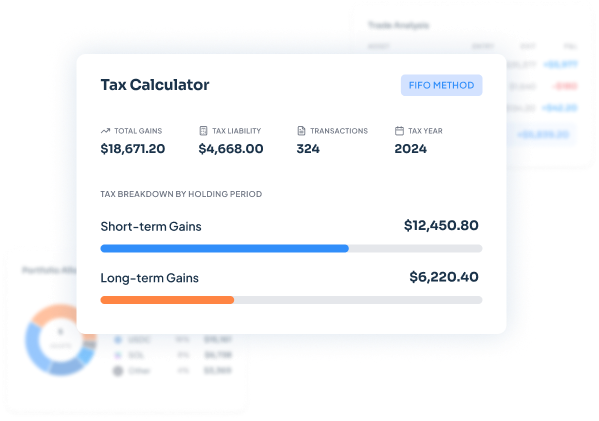
For FIFO, the system automatically matches the earliest acquired tokens with the first disposals. For Specific ID, you must manually assign a cost basis to each token unit or group of units. This involves tracking the purchase price, fees, and any adjustments for staking or yield farming rewards. Accurate cost basis calculation is essential for determining your actual gain or loss when you sell, swap, or otherwise dispose of your tokens.

Report each sale or disposal on IRS Form 8949. If using FIFO, list the transactions in the order they occurred. If using Specific ID, clearly identify each lot by its acquisition date and cost basis. Ensure the total gains and losses from Form 8949 match your tax software calculations. Attach Schedule D to summarize your capital gains and losses for the tax year.

Review your tax report for errors before filing. Check that all transactions are included and that the cost basis calculations are correct. Retain all supporting documentation, including trade confirmations, wallet statements, and transaction hashes, for at least three years from the date you file your tax return. The IRS may request proof of your specific lot identification, so detailed records are crucial.
-
Export all DeFi transaction data from wallets and DEXs
-
Select FIFO or Specific ID based on tax strategy
-
Calculate accurate cost basis for each token lot
-
Complete IRS Form 8949 with correct lot identification
-
Retain transaction records for audit defense
Common DeFi Tax Lot Mistakes
Even with the right software, small errors in how you identify lots can cost you thousands. In DeFi, where transactions are fragmented across chains and protocols, the margin for error is slim. Here are the most frequent pitfalls that lead to poor tax outcomes.
Ignoring Cost Basis Adjustments
Many traders treat every token swap as a fresh start, forgetting that basis adjustments carry over. If you swap ETH for a stablecoin and back, your original cost basis must follow the new holdings. Failing to track these adjustments inflates your apparent gains or wipes out legitimate losses. Always ensure your tracking tool is set to automatically adjust basis after every trade.
Mixing FIFO and Specific ID Incorrectly
The IRS allows you to choose between First-In, First-Out (FIFO) and Specific Identification (Specific ID), but you cannot switch methods mid-year without approval. A common mistake is using FIFO for simple swaps but switching to Specific ID for complex DeFi interactions like liquidity pool deposits. This inconsistency triggers audits. Pick one method and stick to it for all transactions within the same tax year.
Overlooking Airdrops and Staking Rewards
Receiving tokens via airdrop or staking is a taxable event at the fair market value on the day received. Many users ignore these entries because they don't involve a direct sale. However, omitting these creates a gap in your cost basis. When you eventually sell those tokens, the IRS will assume your cost basis is zero, taxing you on the full sale price as pure gain.
Failing to Reconcile Chain Data
DeFi activity spans Ethereum, Arbitrum, Solana, and more. A common error is importing data from only one chain or exchange while ignoring cross-chain bridges. Bridges are not tax-free transfers; they are often treated as sales and repurchases. If you don't reconcile data across all chains, you will miss taxable events or double-count others. Use a aggregator that pulls from all relevant blockchains to ensure a complete picture.
Defi tax lots 2026: what to check next
You can control your tax outcome by choosing how you identify lots, but you must keep your records consistent. The IRS treats FIFO and Specific ID as distinct methods with different audit risks.
No comments yet. Be the first to share your thoughts!