
2026 Reporting Changes: The New Form 1099-DA
The 2026 tax season introduces a structural shift in how digital assets are reported to the IRS via the new Form 1099-DA. This standardized return replaces older information forms, creating a uniform baseline for reporting sales, exchanges, and disposals of digital assets across centralized exchanges and decentralized finance (DeFi) protocols.
Despite the repeal of the broker rule, the burden of cost basis tracking remains entirely on the taxpayer. You must maintain accurate records of your specific tax lots—identifying which tokens were sold or exchanged and at what price—to calculate capital gains or losses correctly. Without this data, you cannot properly fill out Form 8949, potentially leading to overpayment or compliance issues during an audit.
The urgency of this shift is underscored by the complexity of DeFi interactions. Unlike simple buy-and-hold scenarios, DeFi users engage in liquidity provision, yield farming, and token swaps that generate multiple taxable events. As noted in industry analyses, the 2026 filing season requires a clear record of which coins sit in each wallet and how they were acquired, making legacy tracking methods insufficient for modern DeFi strategies.
Yield Farming Taxable Events
DeFi yields are not passive income; they are taxable events that trigger immediate reporting requirements. In 2026, the mechanics of yield farming mean that every interaction with a smart contract can reset your cost basis or create ordinary income. Understanding the distinction between staking rewards and liquidity pool dynamics is essential for accurate lot tracking.
Staking Rewards as Ordinary Income
When you stake tokens to secure a network or validate transactions, the rewards you receive are treated as ordinary income at their fair market value on the date of receipt. This applies to both proof-of-stake networks and liquid staking derivatives. The IRS views these rewards similarly to a paycheck: you owe income tax on the value of the tokens the moment they hit your wallet, regardless of whether you sell them.
This creates a double taxation scenario if you hold the assets. You pay income tax on the reward upon receipt, and then capital gains tax on any appreciation of those rewards when you eventually sell. For example, if you stake ETH and receive 0.05 ETH as a reward, the fair market value of that 0.05 ETH at the time of receipt becomes your cost basis for future capital gains calculations.
Liquidity Pool Withdrawals and Capital Gains
Withdrawing from a liquidity pool is a more complex taxable event. When you provide liquidity, you are effectively swapping your tokens into a pool pair. Providing liquidity is often a taxable swap event in itself, depending on the ratio of tokens deposited and withdrawn. More critically, when you remove liquidity, you are disposing of your interest in the pool.
If the value of your liquidity pool tokens has appreciated since you provided them, the difference between your initial cost basis and the value at withdrawal is a capital gain. This gain is classified as short-term or long-term based on how long you held the liquidity position. If you held the position for less than a year, the gain is taxed at your ordinary income tax rate. If held for more than a year, it qualifies for long-term capital gains rates.
The 2026 Regulatory Context
The regulatory landscape for DeFi has tightened significantly. While the DeFi Broker Rule was repealed, the IRS continues to expand its tracking capabilities through Form 1099-DA data from centralized venues. Taxpayers must maintain precise records of every transaction, including timestamps, fair market values at the time of the transaction, and the specific tokens involved.
Failure to report these events can lead to significant penalties. The complexity of DeFi transactions means that manual tracking is prone to error. Using specialized tax software that integrates directly with blockchain explorers and DeFi protocols is now the standard for compliance in 2026.
FIFO vs LIFO vs Specific ID
Choosing a cost basis accounting method is one of the most consequential decisions for DeFi traders. The method you select determines which tokens are sold first, directly impacting your capital gains tax liability. In a high-volatility market, the difference between methods can mean the difference between a significant tax bill and a deferred liability.
The IRS recognizes three primary methods: First-In, First-Out (FIFO), Last-In, First-Out (LIFO), and Specific Identification. Your choice must remain consistent across tax years unless you receive explicit approval from the IRS to change. For DeFi users dealing with fragmented liquidity across multiple protocols, the mechanics of each method play out differently.
FIFO: The Default Standard
FIFO assumes that the earliest acquired tokens are the first ones sold. This is the default method required by the IRS if you do not specify otherwise. In a bull market, FIFO typically results in higher capital gains because you are selling older, lower-cost tokens. While this maximizes immediate tax liability, it provides a clear, defensible audit trail that requires minimal record-keeping complexity.
LIFO: The Bear Market Hedge
LIFO assumes that the most recently acquired tokens are sold first. This method is less common in DeFi because it requires rigorous tracking of every deposit and withdrawal. In a declining market, LIFO can reduce tax liability by matching recent, lower-cost purchases against current sales. However, it is not available for inventory accounting under current IRS rules for most taxpayers, and its application to digital assets remains a complex, often contested area of tax law.
Specific ID: The Precision Tool
Specific Identification allows you to choose exactly which tokens are sold. This is the most powerful tool for tax optimization in DeFi, enabling you to harvest losses or minimize gains by targeting specific lots. It requires meticulous record-keeping, including timestamps, transaction hashes, and specific lot identifiers. You must identify the specific units before the settlement date and report them correctly on your tax return.
Comparison of Cost Basis Methods
The following table compares the three methods based on their practical impact for DeFi traders.
| Method | Tax Impact | Record-Keeping | IRS Status |
|---|---|---|---|
| FIFO | Higher gains in bull markets | Low (default) | Standard |
| LIFO | Lower gains in bear markets | High | Restricted/Contested |
| Specific ID | Optimized (best/worst) | Very High | Standard (if documented) |
For most DeFi users, Specific Identification offers the best outcome if you have the tools to track it. If not, FIFO remains the safest default. Always consult a tax professional to ensure your chosen method aligns with your specific trading volume and protocol interactions.
Automated DeFi Tax Reporting Tools
High-frequency DeFi activity generates transaction volumes that overwhelm manual spreadsheets. Automated tax reporting tools ingest on-chain data directly from your wallet address, reconstructing your cost basis and identifying taxable events like liquidity pool rebalancing or staking rewards.
For the IRS DeFi tax lot strategy to work, the software must support FIFO, LIFO, and Specific ID methods. These tools map every token swap to a specific acquisition date and price, ensuring you report the correct capital gains classification. Without this granularity, you risk overpaying taxes or triggering audits due to mismatched cost basis data.
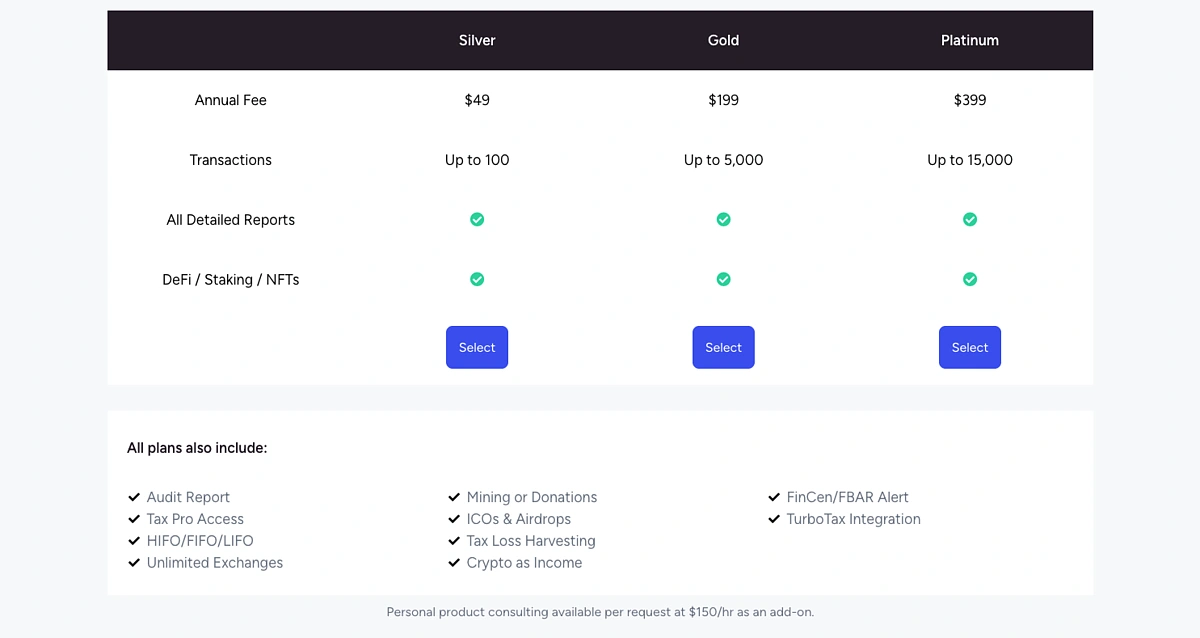
Selecting the right platform requires verifying its ability to handle complex DeFi interactions. The software should explicitly support major DeFi protocols and provide IRS-compliant Form 8949 reports. Avoid tools that only track simple buy-and-sell transactions, as they will miss the tax implications of yield farming, lending, and bridge transfers.
Common DeFi Tax Mistakes to Avoid
The 2026 DeFi landscape introduces new reporting layers, including Form 1099-DA. Even with platform reporting, self-custodial activity remains your responsibility. Missing these details can trigger audits or incorrect cost-basis calculations.
Ignoring Airdrops and Forks
Receiving free tokens via airdrops or hard forks is taxable income at the fair market value on the receipt date. Many investors overlook these because they did not actively purchase the asset. Failure to report this income violates tax law, regardless of whether you sold the tokens immediately.
Miscalculating Liquidity Pool Exits
Withdrawing from liquidity pools often triggers multiple taxable events. Each token removed from the pool may require a separate cost-basis calculation based on your specific lot strategy (FIFO, LIFO, or Specific ID). Treating a pool exit as a single transaction usually results in significant errors in capital gains or losses.
Overlooking Wallet-to-Wallet Transfers
Transferring assets between your own wallets is not a taxable event, but it is a critical tracking requirement. Without proper documentation, a transfer can be misinterpreted as a sale or disposal. Maintain clear records of internal movements to prove ownership continuity during any potential audit.
-
Verify all airdrop and fork income was reported at receipt value
-
Recalculate cost basis for each token withdrawn from liquidity pools
-
Document all internal wallet transfers to distinguish from sales
No comments yet. Be the first to share your thoughts!