
Understand the 2026 reporting changes
The regulatory landscape for digital assets has shifted with the introduction of Form 1099-DA, designed to standardize reporting across the industry. By mid-February 2026, most centralized exchange users will receive this form, which outlines their transaction history and cost basis for the prior year [[src-serp-2]]. This move marks a significant departure from the era of purely self-reported crypto taxes, bringing digital asset reporting closer to traditional securities compliance.
However, this new framework primarily targets centralized intermediaries. Brokers are now required to report basis for transactions occurring on or after January 1, 2026, but only for digital assets acquired from and held with that specific broker [[src-serp-6]]. This limitation means that while your Coinbase or Kraken activity may be neatly summarized, your interactions with decentralized protocols remain largely outside this automated net.
For DeFi participants, the absence of a centralized broker means you cannot rely on pre-filled forms. You must still calculate your cost basis for staking rewards, liquidity provider (LP) positions, and other on-chain activities. Understanding this distinction is critical: the new forms simplify the life of the centralized user but leave the DeFi user to manage the complexity of their own tax records.
Track every DeFi transaction
Centralized exchanges like Coinbase or Binance will eventually send you a Form 1099, but they cannot report activity that happens on decentralized protocols. If you interacted with Uniswap, Aave, or any liquidity pool, your gains are invisible to the IRS unless you track them yourself. The blockchain is public, but the data is fragmented across dozens of wallets and chains.
To build a defensible cost basis, you must aggregate every on-chain interaction into a single ledger. This process requires exporting raw transaction histories and reconciling them with your fiat on-ramps. Treat your wallet addresses like bank accounts: if you don't record the deposit, you can't prove the cost.

Connect your hardware wallet or browser wallet extension to a block explorer like Etherscan or Solscan. Use the "Export Transaction History" feature to download a CSV file. Ensure you select the correct network (Ethereum, Arbitrum, Polygon, etc.) and include all token transfers, not just ETH or SOL. You must repeat this for every wallet address you used to interact with DeFi protocols.

Upload your CSV files to a tax platform that supports smart contract interactions. Standard broker software often fails to decode complex DeFi transactions like liquidity pool additions or staking rewards. Look for tools that can automatically parse internal transactions and identify taxable events like swaps, lending interest, and liquidity provision rewards. This step transforms raw blockchain data into a readable transaction log.

Link your centralized exchange accounts or bank statements to your tax software. Import your fiat deposits and withdrawals. This allows the software to calculate your cost basis for the crypto you bought with dollars. Without this reconciliation, the software cannot determine the original purchase price of the tokens you later staked or swapped in DeFi, leading to inflated tax liabilities.
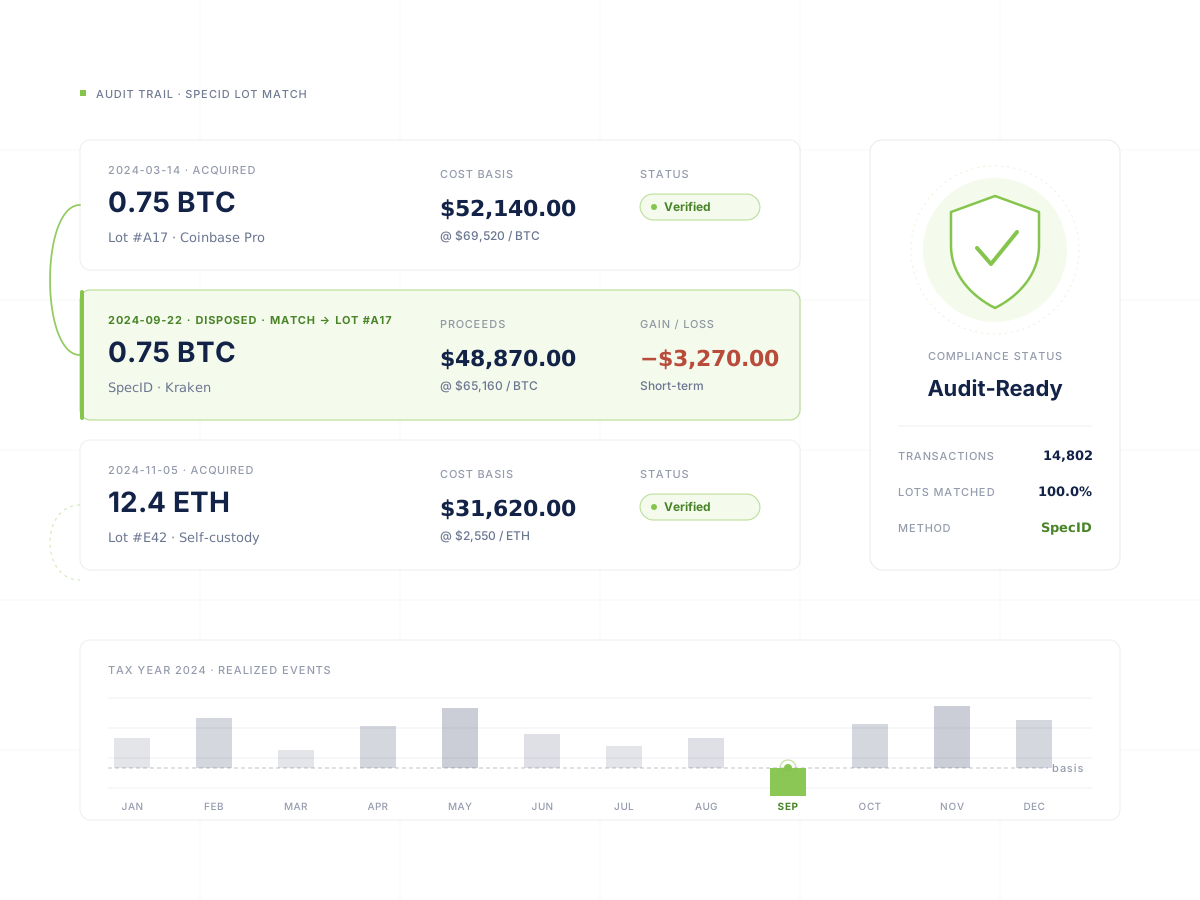
Cross-check your imported transactions against the block explorer. Ensure that every swap, deposit, and withdrawal is accounted for. If you see "missing" transactions in your tax report, it usually means the smart contract interaction was too complex for the importer to parse automatically. Manually review these discrepancies to ensure your cost basis is accurate before filing.
The IRS has access to advanced blockchain analytics tools that can trace "hidden" wallets [1]. Relying on the assumption that decentralized activity is untraceable is a high-stakes error. By maintaining a complete, exported ledger, you create a clear audit trail that simplifies your cost basis calculation and reduces the risk of an audit.
[1] https://www.youtube.com/watch?v=-eObf13S6tY
Calculate Fair Market Value for Staking and Airdrops
When you receive staking rewards or airdrops, the IRS treats them as ordinary income. You must report the fair market value (FMV) of the tokens at the exact moment you gain control of them. This value becomes your cost basis for future tax calculations.
Step 1: Identify the receipt timestamp
Locate the precise transaction timestamp when the tokens were deposited into your wallet. For staking, this is often the block time of the reward distribution. For airdrops, it is the timestamp when the tokens first appeared in a wallet you control. Use a DeFi tax tracker to pull this data directly from the blockchain to avoid manual entry errors.
Step 2: Determine the USD value
Find the market price of the token at that specific second. If the token was not yet listed on any exchange, consult the primary source for the valuation method, such as CoinMarketCap or CoinGecko, or use the price from the first DEX pool where it traded. Record this USD amount as your income.
Step 3: Record as ordinary income
Enter the token amount and the USD value into your tax software under "Staking Income" or "Airdrop Income." This step establishes your cost basis. If you sell the tokens immediately, you will have a short-term capital gain or loss equal to the difference between the sale price and this recorded FMV.
Common pitfalls to avoid
- Ignoring unclaimed airdrops: If you received tokens but never moved them to a wallet you control, you may not have taxable income yet. However, once you claim or transfer them, FMV applies.
- Using average prices: Do not use the daily average price. The IRS requires the price at the exact time of receipt.
- Double-counting: Ensure you do not report the same staking reward as both income and capital gain. The FMV at receipt is income; any subsequent price change is capital gain/loss.
Determine LP token cost basis
Calculating the cost basis for liquidity pool (LP) tokens requires tracking the specific assets you deposited into the pool. When you provide liquidity, you are exchanging standard tokens (like ETH and USDC) for LP tokens. The IRS treats this deposit as a disposition of the original tokens, potentially triggering immediate taxable events depending on the pool structure and your jurisdiction.
To determine your cost basis for the LP tokens, you must sum the fair market value of the assets contributed at the exact moment of deposit. This total becomes your cost basis for the LP token position. If you deposited 1 ETH valued at $2,000 and 2,000 USDC, your cost basis for the LP token is $4,000. This figure serves as the baseline for calculating gains or losses when you later remove liquidity.
Removing liquidity is a taxable event. When you withdraw assets from the pool, you are disposing of the LP tokens. The gain or loss is calculated by comparing the fair market value of the assets withdrawn against your original cost basis.
You can use two primary methods to track this basis: FIFO and Specific Identification. FIFO assumes the first tokens deposited are the first ones withdrawn. Specific Identification allows you to choose exactly which batch of deposited tokens you are withdrawing. This method is often more precise for complex LP positions with multiple entries and exits.
| Method | How It Works | Tracking Complexity | Best Used When |
|---|---|---|---|
| FIFO (First-In, First-Out) | Automatically assumes the earliest deposited assets are withdrawn first. | Low | Simple, single-entry LP positions. |
| Specific Identification | Allows manual selection of the specific LP token batch being withdrawn. | High | Complex positions with multiple deposits/withdrawals to minimize tax. |
If you use Specific Identification, you must maintain detailed records of each deposit event, including the date, time, asset values, and the resulting LP token amount. Without this granularity, you may be forced to use FIFO by tax authorities, which could result in higher taxable gains if early deposits had a lower cost basis than later ones.
Always consult a qualified tax professional to ensure your LP token accounting complies with current regulations. DeFi tax laws are evolving, and errors in cost basis calculation can lead to significant penalties during an audit.
Reconcile with Form 1099-DA
The introduction of Form 1099-DA marks a shift from self-reported estimates to broker-verified data. By mid-February 2026, exchanges and custodians begin issuing these forms to standardize digital asset reporting [[src-serp-2]]. Your goal is not to accept these numbers blindly, but to use them as a baseline for a full audit of your DeFi activity.
Step 1: Gather All 1099-DA Forms
Collect every 1099-DA you receive from centralized exchanges, DeFi protocols with reporting capabilities, and custodial wallets. These forms aggregate data from that specific platform. Because DeFi liquidity is fragmented, you will likely receive multiple forms from different issuers. Treat this as your "external truth" to compare against your own records.
Step 2: Final Pre-Filing Verification
Before submitting your return, perform a final reconciliation. Ensure that all capital gains and losses from Form 1099-DA are correctly transferred to Schedule D of your tax return. Verify that any net losses are properly applied against capital gains or the $3,000 ordinary income limit.
Common DeFi tax mistakes to avoid
DeFi complexity creates multiple opportunities for reporting errors. Many users focus on major trades while overlooking smaller events that still trigger tax obligations.
Ignoring small airdrops and rewards
Every token received through staking rewards, airdrops, or governance distributions counts as taxable income at fair market value on the receipt date. Small amounts still add up. Failing to track these micro-transactions leads to underreported income.
Miscalculating gas fees as income
Gas fees are transaction costs, not income. They reduce your cost basis or count as capital losses depending on the transaction type. Treating gas payments as taxable income inflates your tax liability unnecessarily.
Failing to track basis across chains
Tokens moved between chains require careful cost basis tracking. Bridging assets does not create a taxable event, but losing track of original purchase prices makes future calculations impossible. Use chain-agnostic tracking tools to maintain accurate records.
FAQs on DeFi tax 2026
The introduction of Form 1099-DA marks a significant shift in how the IRS tracks digital asset transactions. As reporting standards evolve, understanding how these forms interact with DeFi activities is essential for accurate cost basis calculation.
Do I receive Form 1099-DA for my DeFi transactions?
Starting in 2026, the IRS introduced Form 1099-DA to standardize digital asset reporting. By mid-February 2026, you should receive this form from centralized exchanges and certain DeFi protocols that comply with new reporting mandates. However, many decentralized protocols do not yet issue these forms, meaning you remain responsible for tracking and reporting your own basis. Always verify which of your counterparties are reporting to the IRS.
How is impermanent loss treated for tax purposes?
Impermanent loss is generally not a taxable event in itself because it represents an unrealized difference in value while your assets remain in a liquidity pool. Taxable events typically occur when you withdraw your liquidity, providing a realized gain or loss. The cost basis for your withdrawn tokens is calculated based on the original value of your deposits adjusted for any fees or rewards received during the period.
Do I need to report staking rewards separately?
Yes. Staking rewards are considered ordinary income at the fair market value of the tokens when you receive them. You must report this income on your tax return even if you do not sell the tokens. When you eventually sell the staked tokens, your cost basis is the value you reported as income, which determines whether you have a capital gain or loss upon sale.
No comments yet. Be the first to share your thoughts!