
New IRS rules for 2026 filings
The 2026 filing season marks a structural shift in how the Internal Revenue Service tracks digital asset activity. With the introduction of Form 1099-DA, the agency is moving away from purely self-reported data toward standardized exchange reporting. This change directly impacts DeFi participants, as Layer 2 networks and bridge transactions now generate the kind of transactional data previously hidden from traditional tax forms.
For those managing assets across multiple Layer 2 chains, the stakes are higher than in previous years. The IRS has enhanced its on-chain tracking capabilities, meaning that bridge transactions between mainnets and L2s are no longer invisible. Each bridge deposit and withdrawal can trigger a taxable event if not properly documented, creating a minefield for investors who do not meticulously track their cross-chain movements.
Experts warn that the 2026 filing season will be particularly messy for crypto investors. The combination of new reporting requirements and the complexity of DeFi mechanics means that precise record-keeping is no longer optional. You must track every bridge transaction and L2 fee payment to ensure your DeFi tax 2026 reporting is accurate and defensible.
Track L2 gas fees as cost basis
Layer 2 networks like Arbitrum, Optimism, and Base require gas payments in ETH or native L2 tokens. The IRS treats these payments as a disposal of assets, creating a taxable event if the value of the gas token has appreciated since acquisition. Ignoring this mechanic leads to underreported gains and audit flags.
To report Layer 2 gas fees correctly, you must track every transaction where ETH or an L2 token is burned to pay for network fees. Treat each burn as a sale of that specific amount of crypto. If you acquired ETH at $1,500 and use $10 worth of ETH to bridge assets when ETH is trading at $3,000, you have realized a $5 gain on that portion of ETH. This gain is short-term or long-term depending on your holding period for the burned ETH.

Import your L2 wallet data into a tax software that supports Layer 2 networks. Ensure the software distinguishes between the L2 native token (e.g., ETH on Arbitrum) and the mainnet token. Mislabeling these leads to incorrect cost basis calculations.

Mark every transaction where you send ETH or an L2 token to a gas contract or fee aggregator as a disposal. Do not treat these as transfers. The IRS views the burning of gas as a sale of the asset used to pay the fee.

Apply your chosen accounting method (FIFO, LIFO, or Specific ID) to the ETH or L2 token used for gas. If you used Specific ID, match the exact batch of ETH burned to its original purchase price. For FIFO, assume the earliest acquired ETH was used to pay the fee.
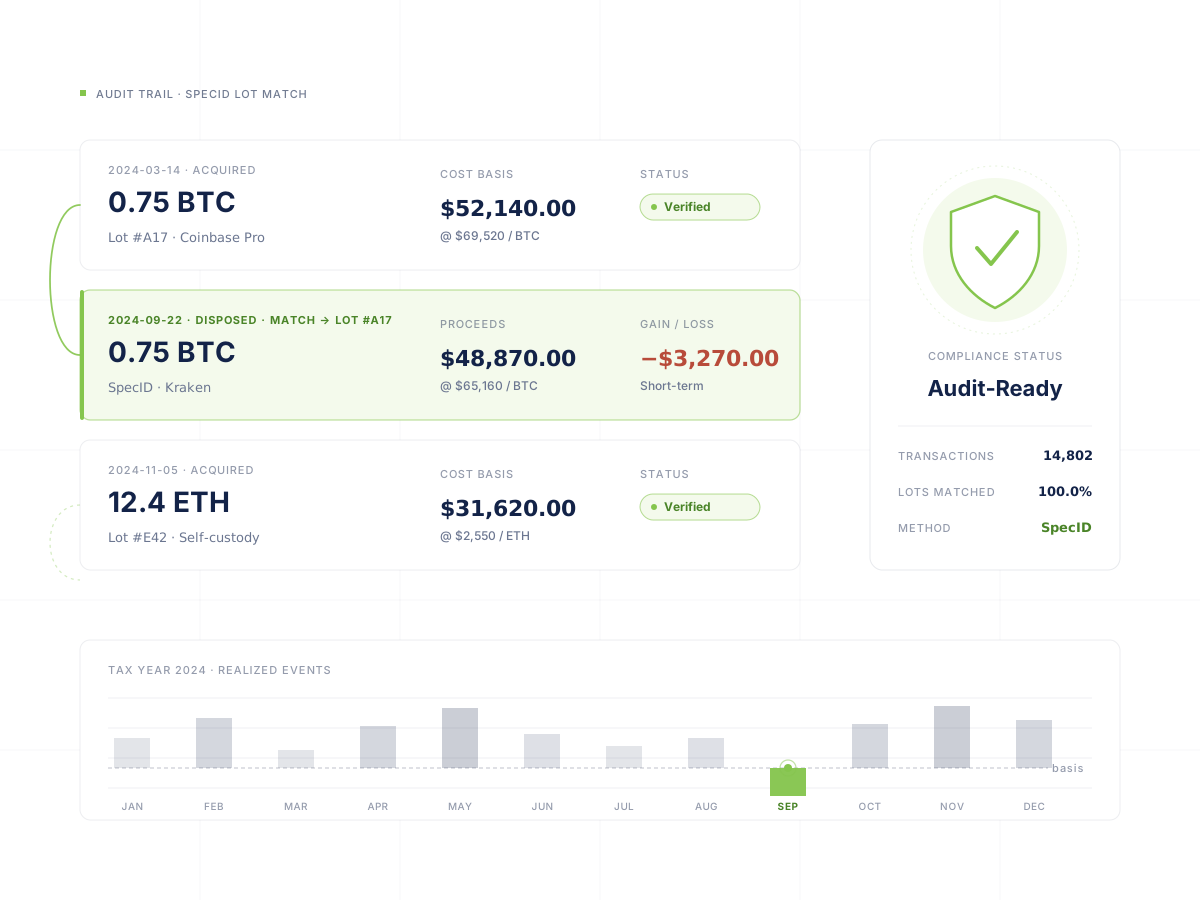
Record the difference between the fair market value of the gas at the time of the burn and its cost basis. This figure is your taxable gain or deductible loss. Aggregate these small gains across all L2 transactions to report on Schedule D.
Double-counting is the most common error in DeFi tax reporting. If you claim the gas fee as a miscellaneous deduction on Schedule 1, you cannot also report a gain on the disposal of the gas token. You must choose one treatment: either deduct the fee (if allowable and you have the basis) or report the disposal gain/loss. For most high-frequency L2 users, reporting the disposal gain/loss is the only accurate method, as the "expense" is effectively the difference between the sale price and cost basis.
Calculate bridge transaction lots
DeFi Tax works best as a clear sequence: define the constraint, compare the realistic options, test the tradeoff, and choose the path with the fewest hidden costs. That order keeps the advice usable instead of decorative. After each step, pause long enough to check whether the recommendation still fits the reader's actual situation. If it depends on perfect timing, unusual access, or a best-case budget, include a simpler fallback.
| Factor | What to check | Why it matters |
|---|---|---|
| Fit | Match the option to the primary use case. | A good deal still fails if it does not fit the job. |
| Condition | Verify age, wear, and service history. | Hidden condition issues erase upfront savings. |
| Cost | Compare purchase price with likely upkeep. | The cheapest option is not always the lowest-cost option. |
Avoid common DeFi reporting errors
Reporting Layer 2 fees and bridge transactions requires precision. The IRS tracks on-chain activity using advanced analytics, meaning "hidden" wallets do not protect you from scrutiny. Misclassifying these transactions is a primary cause of tax underpayment notices.
Gas fees and cost basis
Many users omit gas fees paid in native tokens (ETH, MATIC, OP) when calculating the cost basis of a sale. This inflates your taxable gain. You must subtract the gas fee from your proceeds or add it to your cost basis, depending on how your software tracks it.
- Identify the native token used for gas (e.g., ETH on Arbitrum).
- Determine the fair market value of the gas fee at the exact time of the transaction.
- Subtract this value from your gross proceeds or add it to your cost basis.
Bridge transactions
Bridging assets between L1 and L2 is often misreported as a non-taxable transfer. While moving assets to your own wallet is not a taxable event, bridging via a centralized intermediary or a liquidity pool can trigger a disposal. If the bridge swaps your asset for a different token before depositing, it is a taxable swap.
- Self-custody bridges: Generally non-taxable if you retain ownership of the underlying asset.
- Wrapped assets: Wrapping ETH to WETH is not taxable. Unwrapping is not taxable.
- Cross-chain swaps: If the bridge exchanges one token for another, it is a taxable disposal.
Unreported airdrops and staking
Airdrops are taxable as ordinary income at fair market value upon receipt. Staking rewards are also taxable upon receipt. Do not wait until you sell the asset to report these events. The IRS considers these events as income, not capital gains, at the moment you gain control of the tokens.
Proof of tracking
Maintain detailed logs of all L2 transactions. Use block explorers like Arbiscan or Optimistic Etherscan to verify your records. If your tax software misses a transaction, you may need to file an amended return. Accuracy is your best defense against an audit.
Verify your tax lots before filing
Before submitting your return, treat your DeFi tax lot verification as a final audit. The introduction of Form 1099-DA in 2026 standardizes reporting, but it does not automatically reconcile complex Layer 2 activity or bridge transactions. You must manually cross-reference your internal records against these new official forms to identify discrepancies. MetaMask outlines the specific reporting requirements for 2026, emphasizing that platform-generated forms may not capture every bridge hop or L2 gas fee payment.
Follow this sequence to ensure your tax lots are accurate and defensible.

Download all 1099-DA forms from your exchanges and L2 providers. Compare the reported gross proceeds and cost basis against your personal transaction ledger. Flag any transactions that appear on the form but are missing from your records, or vice versa. Discrepancies here are the most common trigger for IRS notices.
Gas fees paid on Layer 2 networks (e.g., Arbitrum, Optimism, Base) are deductible expenses. Verify that your wallet history captures every ETH or native token payment used for gas. Ensure these are categorized as separate cost-basis adjustments, not mixed into the principal of the asset being transferred.
Bridges are not taxable events, but they require careful lot tracking. When you bridge assets from Ethereum Mainnet to an L2, the cost basis carries over. Confirm that your software maintains the original acquisition date and price for these bridged assets. If you bridge back, ensure the lot identification remains consistent to prevent phantom gains.
Some decentralized exchanges (DEXs) and non-custodial wallets do not issue tax forms. You are legally responsible for reporting these transactions. Use block explorers to pull full transaction histories for any DEX interactions and manually enter them into your tax calculation spreadsheet. Do not rely on platform summaries for DEX activity.
Apply the correct 2026 tax rates to your realized gains. Long-term capital gains are taxed at 0%, 15%, or 20% depending on your taxable income, while short-term gains are taxed as ordinary income. Ensure your lots are correctly labeled as short-term (held ≤1 year) or long-term (held >1 year) before final submission.
Use this checklist to confirm you have completed every verification step.
No comments yet. Be the first to share your thoughts!