
Get DeFi tax 2026 right
Before you start calculating liabilities, you need to establish a single source of truth. The 2026 tax year introduces Form 1099-DA, which requires exchanges to report digital asset transactions directly to the IRS by mid-February. This new reporting standard means your internal records must align perfectly with what platforms submit, or you risk triggering audits for unreported income.
Cross-chain bridge transfers and MEV rewards create unique tracking challenges that standard spreadsheets often miss. Bridges are not taxable events themselves, but they move assets between wallets where subsequent actions are. MEV rewards, however, are taxable income the moment you receive them. To handle this correctly, you must first aggregate all wallet activity before applying tax logic.
The following steps outline how to prepare your data for accurate reporting. Focus on completeness first; accuracy follows only after you have every transaction recorded across all chains and protocols.
Download CSV exports from all centralized exchanges and bridge platforms. Use blockchain explorers like Etherscan or Solscan to export raw transaction histories for any wallets used in DeFi. Ensure you capture the exact timestamp and USD value at the moment of each interaction.

Mark bridge deposits and withdrawals as non-taxable transfers between your own wallets. However, flag any token swaps that occur during the bridging process as taxable trades. Separate these from simple transfers to avoid double-counting capital gains.
Record all MEV rewards as ordinary income at their fair market value on the date received. This includes liquid staking rewards, arbitrage profits, and any other incentives distributed by protocols. Assign a cost basis equal to the value at receipt for future gain/loss calculations.
Work through the steps
The IRS introduced Form 1099-DA in 2026 to standardize digital asset reporting, but it does not capture every on-chain event. You will still need to manually report cross-chain bridge transfers and MEV rewards to avoid discrepancies during an audit. These activities require specific handling to ensure your cost basis and income reporting align with current regulations.

Cross-chain bridges often trigger taxable events depending on how the protocol is structured. If you use a non-custodial bridge that involves swapping assets on a decentralized exchange (DEX) before bridging, that swap is a disposal event. Log the timestamp, the asset sent, the asset received, and the fair market value at the exact moment of the transaction. Do not assume that moving assets between chains is tax-free; only true 1:1 custodial transfers may qualify as non-taxable, and even those require careful documentation to prove no value was realized.

Maximum Extractable Value (MEV) rewards, whether from block building, arbitrage, or liquidations, are generally treated as ordinary income at the time you gain control of the assets. Record the fair market value of the MEV tokens in USD when they are credited to your wallet. This applies to rewards from protocols like Flashbots or direct validator payouts. Failure to report these as income can lead to significant penalties, as the IRS views these as compensation for services rendered by your validator or bot.

Once you have compiled your internal ledger, compare it against the Form 1099-DA you receive from reporting exchanges and brokers by mid-February. The 1099-DA will show proceeds and cost basis for transactions reported by those specific entities. Your on-chain activity, especially bridge transfers and MEV rewards from non-reporting protocols, will likely be missing from this form. Use the 1099-DA as a starting point, but add all unreported on-chain activities to your tax return using Schedule D and Form 8949.
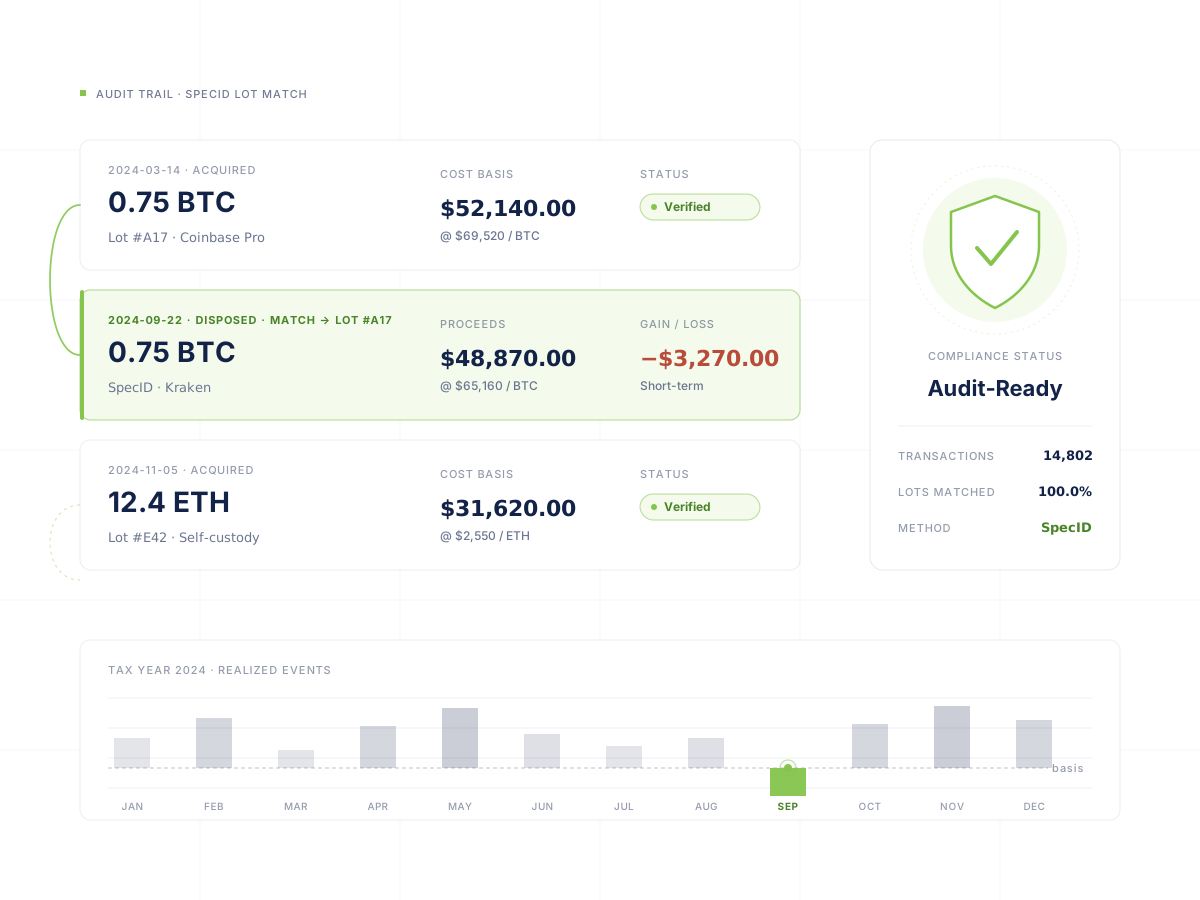
Keep a detailed record of how you calculated the fair market value for each bridge transfer and MEV reward. Use the same pricing source (e.g., CoinGecko, CoinMarketCap, or DEX spot price) consistently throughout the year. If you are audited, the IRS will expect you to demonstrate that your valuations were reasonable and consistently applied. Save screenshots of the transaction hashes and the price oracle data used at the time of the event.
Common mistakes in cross-chain bridge and MEV tax reporting
Cross-chain bridges and MEV (Maximal Extractable Value) rewards introduce complexity that standard tax software often mishandles. Misclassifying these events leads to double taxation or missed income, creating discrepancies when the IRS reviews Form 1099-DA data against your personal records.
Treating bridge transfers as taxable sales
Moving assets between chains is not a taxable event. When you bridge ETH from Ethereum to Arbitrum, you are not selling the asset; you are moving it to a different ledger. Reporting this as a disposal triggers a false capital gain calculation.
The fix: Ensure your tax software marks bridge transactions as "non-taxable transfers." Only the final withdrawal from the bridge to a centralized exchange or the sale of the bridged asset should be recorded as a taxable event.
Ignoring MEV rewards as ordinary income
MEV rewards, such as those from flashbots or liquidity mining incentives, are taxable as ordinary income at the fair market value when received. Many users overlook these small, automatic deposits because they appear as "gas refunds" or complex internal transactions.
The fix: Import your on-chain history directly from block explorers like Etherscan or Arbiscan. Manually review incoming transactions labeled as rewards or incentives. Record the USD value at the exact timestamp of receipt as ordinary income.
Failing to track cost basis across chains
When you bridge assets, the cost basis carries over. If you bought ETH for $2,000 and bridge it, your new basis on Arbitrum is still $2,000. Selling it later for $3,000 results in a $1,000 gain, not a full $3,000 gain.
The fix: Use a tax tool that supports cross-chain cost basis tracking. Verify that the basis from the source chain is correctly inherited by the destination chain in your reports before filing.
Defi tax 2026: what to check next
Navigating DeFi taxes in 2026 requires precision, especially with cross-chain activity and new reporting forms. Here are the most common practical questions.
No comments yet. Be the first to share your thoughts!