
What changed for DeFi tax reporting
The 2026 tax season introduces a complex landscape for DeFi users. The IRS repealed the proposed "DeFi Broker Rule," which would have forced decentralized protocols to act as tax brokers. However, the agency retained strict cost-basis tracking requirements for all digital asset transactions. This creates a high-stakes environment where the burden of accurate reporting falls entirely on the individual.
Without the automated data collection that a broker would provide, users face a "perfect storm" of manual tracking. Every swap, liquidity provision, and airdrop must be accounted for individually. This shift means that relying on memory or simple spreadsheet logs is no longer sufficient for compliance. The margin for error has shrunk, making precise lot selection critical for minimizing tax liability.
Experts describe the 2026 filing season as messy and potentially fraught with complications. The absence of standardized 1099 forms from DeFi platforms means that discrepancies between user records and IRS expectations are more likely. Accurate cost-basis tracking is no longer just a best practice; it is the primary defense against audits and penalties.
Track DeFi tax lots with this workflow
Accurate cost basis tracking requires matching every DeFi transaction to a specific acquisition lot. The IRS treats DeFi activities—swaps, yield farming, and liquidity provision—as taxable events that must be reported with precise cost and fair market value data. This workflow walks you through identifying, recording, and reconciling those lots to ensure your reporting stands up to scrutiny.

Start by aggregating all on-chain activity into a single dataset. Use blockchain explorers or DeFi analytics platforms to pull raw transaction hashes for every wallet address you control. Ensure you capture all interactions, including bridge transfers, which may trigger taxable events depending on the jurisdiction. This raw data serves as the foundation for all subsequent lot identification.
Not every transaction results in a tax liability, but most DeFi interactions do. Categorize each transaction from your export: swaps are taxable exchanges, yield farming rewards are ordinary income at fair market value, and liquidity pool withdrawals may trigger capital gains or losses. Distinguish between non-taxable transfers (like moving assets between your own wallets) and taxable disposals to avoid over-reporting.
Link each taxable disposal to a specific acquisition lot. The IRS generally requires Specific Identification (Spec ID) or First-In, First-Out (FIFO) methods for crypto assets. If using Spec ID, you must clearly identify which tokens were sold and their original acquisition date and cost. If using FIFO, the earliest acquired tokens are deemed sold first. Consistency is critical; switch methods only if permitted by tax law and documented properly.
Compare your calculated gains and losses against any exchange-issued tax forms, such as the proposed Form 1099-DA. Reconciling these figures helps catch missing transactions or valuation errors. If your on-chain data conflicts with a broker's report, prioritize the on-chain data as it reflects the actual economic activity, but be prepared to explain the discrepancy if audited.
Handle swaps, staking, and liquidity pools
DeFi mechanics create fragmented tax lots that standard wallets rarely track. Unlike centralized exchanges that provide a single cost-basis report, decentralized protocols split transactions across multiple blocks and bridges. You must manually trace each event to establish your adjusted cost basis.
Track liquidity pool deposits
Adding liquidity to a pool is not a taxable event in most jurisdictions, but it creates two new cost lots. When you deposit a pair of tokens (e.g., ETH and USDC), you retain the original cost basis for each asset. The pool issues LP tokens representing your share. These LP tokens become the new asset you must track for future sales or withdrawals.
Calculate yield and staking rewards
Earning yield through staking or liquidity mining generates ordinary income at the fair market value of the token at the moment of receipt. This value becomes your new cost basis for those specific tokens. If you stake ETH and receive stETH, the initial receipt of stETH is income. Any subsequent appreciation or disposal of stETH triggers a separate capital gain or loss calculation based on that initial income basis.
Manage impermanent loss and withdrawals
Withdrawing from a liquidity pool is a taxable event. You are effectively selling your LP tokens back into the underlying assets. To calculate the gain or loss, compare the fair market value of the tokens you receive upon withdrawal against the original cost basis of the LP tokens you held. Impermanent loss affects the quantity of assets you receive, but the tax liability is determined by the difference between your entry cost and the exit value.
Common pitfalls in DeFi tracking
- Forgotten bridge transactions: Moving assets across chains (e.g., Ethereum to Arbitrum) can sometimes trigger taxable events if the bridge structure involves a token swap rather than a simple transfer.
- Airdrop confusion: Receiving governance tokens as an airdrop is taxable income. If you provide liquidity to earn these tokens, you must report the income and then track the new tokens separately.
- Complex fee structures: Some protocols charge fees in native tokens rather than the traded pair. These fees may be deductible as transaction costs, reducing your capital gain, but they require precise record-keeping.
Use a dedicated DeFi tax tool to aggregate these fragmented events. Manual tracking across multiple chains is error-prone and increases the risk of underreporting income. Ensure your software supports the specific protocols you use, as generic trackers often miss complex yield farming mechanics.
Avoid the FIFO tax lot trap
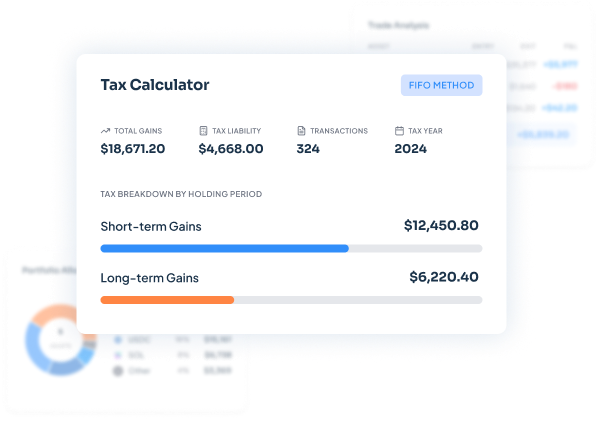
When you sell a cryptocurrency, you must tell the IRS which specific coins you are selling. The default method is First-In, First-Out (FIFO), which assumes the oldest coins in your wallet are the ones being disposed of. While FIFO is simple to track, it often results in the highest possible tax bill for DeFi users in 2026.
In a volatile market, your earliest holdings were likely acquired when prices were much lower. Selling those first locks in a large unrealized gain, converting what might have been a modest profit into a substantial capital gains event. If you had held onto those older coins and sold more recent, higher-cost acquisitions instead, your taxable profit would be significantly smaller.
Using FIFO can unnecessarily increase your capital gains tax. If your platform supports it, Specific Identification allows you to choose which specific coins to sell, often resulting in lower taxes.
The IRS permits Specific Identification for cryptocurrency transactions, provided you can clearly identify which coins are being sold and you consistently apply this method to your tax reporting. This requires meticulous record-keeping. You must document the date acquired, cost basis, and date sold for each specific token unit.
If your DeFi platform or wallet does not automatically track lots, you must use a tax software that supports Specific Identification. Manually tracking this data is error-prone and time-consuming. Without proper documentation, the IRS may default to FIFO against you, leaving you with a higher tax bill than necessary.
Verify your data before filing
DeFi Tax Lots works best as a clear sequence: define the constraint, compare the realistic options, test the tradeoff, and choose the path with the fewest hidden costs. That order keeps the advice usable instead of decorative. After each step, pause long enough to check whether the recommendation still fits the reader's actual situation. If it depends on perfect timing, unusual access, or a best-case budget, include a simpler fallback.

Common DeFi tax questions for 2026
Navigating DeFi taxation requires distinguishing between standard crypto transactions and complex protocol interactions. The following questions address the most frequent compliance challenges for 2026.
No comments yet. Be the first to share your thoughts!