

In the volatile world of DeFi, where trades span Ethereum, Solana, and Base, precise tracking of profit and loss through real-time onchain PnL tools has become non-negotiable for serious investors. As a CFA charterholder with roots in Wall Street portfolio management, I've long advocated for conservative precision over speculative frenzy. Platforms like DefiTaxLots. com stand out by delivering onchain data visualization tailored for DeFi traders, enabling seamless management of tax lots via FIFO and LIFO methods. This isn't just about numbers; it's about safeguarding your portfolio against tax pitfalls in a multi-chain landscape.
Deciphering FIFO and LIFO for DeFi Tax Lots
First-In, First-Out (FIFO) assumes the earliest acquired assets are sold first, a default method in many jurisdictions that aligns with conservative accounting principles. Last-In, First-Out (LIFO), conversely, treats the most recent purchases as disposed first, potentially optimizing short-term gains in rising markets but inviting scrutiny from regulators. For DeFi users juggling Uniswap swaps on Ethereum, Orca liquidity on Solana, or Aerodrome positions on Base, choosing between these methods hinges on your holding period and tax strategy.
Consider a trader who accumulated ETH at varying costs over months. Under FIFO, selling a portion realizes gains based on the oldest, likely cheapest lots, often yielding long-term capital gains treatment if held over a year. LIFO flips this, matching sales to fresher, pricier lots, which might defer taxes in bull runs but inflate taxable events during downturns. My experience shows FIFO suits long-term holders, minimizing exposure to market swings, while LIFO demands vigilant monitoring.
FIFO vs LIFO: Tax Lot Comparison with ETH Example (Buys at $2,000, $3,000, $4,000; Sale at $3,500)
| Method | Assumption | Tax Impact (Bull Market) | Tax Impact (Bear Market) | Best For |
|---|---|---|---|---|
| FIFO (First-In, First-Out) | Oldest lot sold first\nCost basis: $2,000\nGain on sale: $1,500 | Higher taxes\nRealizes larger gains early (low cost basis) | More favorable\nMaximizes losses (low basis sold first) | Bear markets & tax-loss harvesting 📉 |
| LIFO (Last-In, First-Out) | Newest lot sold first\nCost basis: $4,000\nLoss on sale: $500 | Lower taxes\nSmaller gains/losses early, defers large gains | Less favorable\nMinimizes losses (high basis sold first) | Bull markets 📈 |
These distinctions grow acute in DeFi, where onchain PnL trackers must parse complex transactions like liquidity provision yields or airdrop claims across chains.
Multi-Chain Complexities in Ethereum, Solana, and Base
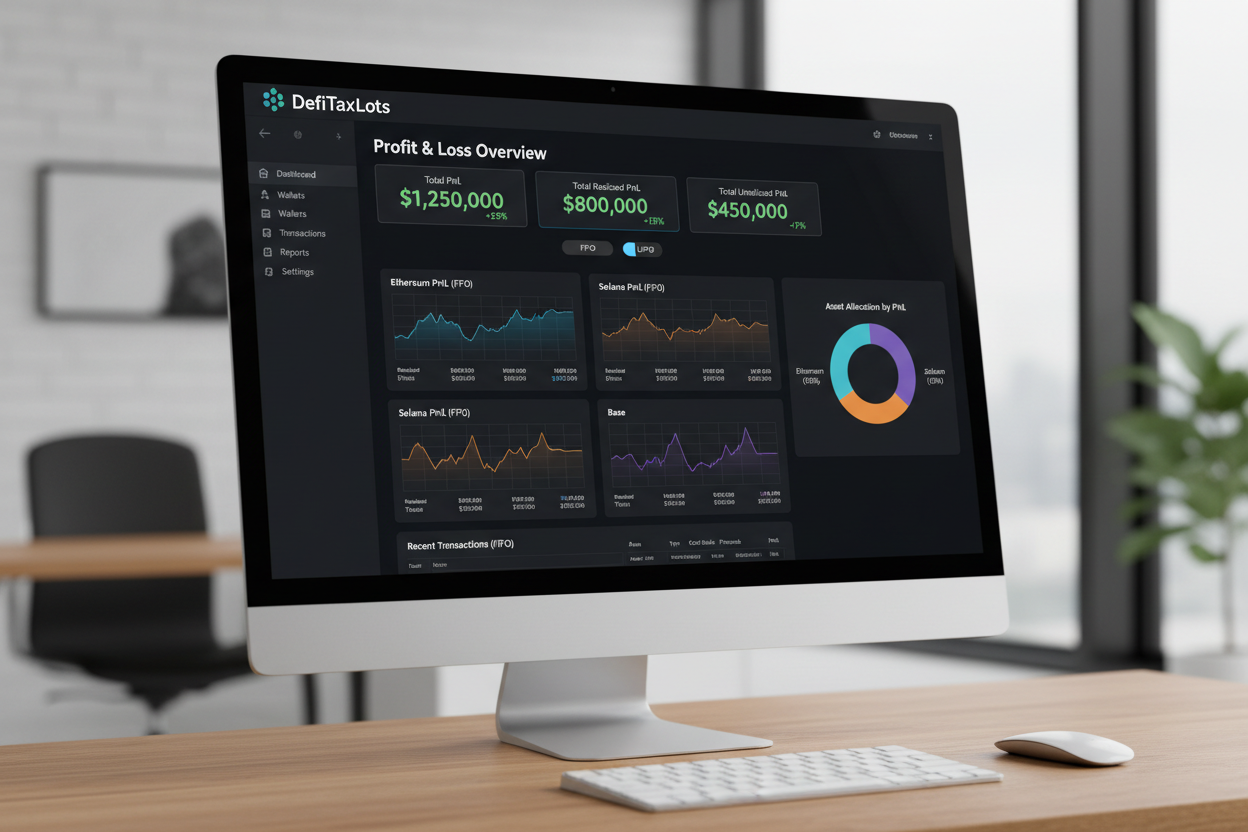
Ethereum's mature ecosystem hosts heavyweights like Uniswap V3, demanding granular tracking of concentrated liquidity positions. Solana's high-speed environment amplifies volume, with DEXes like Jupiter aggregating trades that blur lot identification. Base, as an optimistic rollup, introduces Layer 2 nuances, where bridging assets complicates cost basis continuity. A defi pnl tracker must unify these, providing onchain pnl real-time insights without manual reconciliation.
Tools like LedgerLynx and PnLynx excel here, auto-discovering histories via wallet connections and applying FIFO or LIFO across chains. Koinly and Nansen complement with broader support, including HIFO for optimization, though I caution against aggressive methods without professional advice. In my view, conservative users prioritize platforms verifying every tx hash, ensuring defi tax lots fifo lifo calculations withstand audits.
Patience and precision beat speculation every time.
Yet, pitfalls abound: impermanent loss in pools, MEV-induced slips, and cross-chain transfers that FIFO misattributes if not timestamped accurately. Real-time trackers mitigate this by ingesting blockchain data directly, bypassing exchange APIs prone to lags.
Essential Features of Leading Onchain PnL Trackers
Evaluating defi pnl tracker options reveals DefiTaxLots. com's edge in intuitive multi-chain support for Ethereum, Solana, and Base. Its FIFO/LIFO engine generates compliant reports, streamlining multi-chain crypto taxes and ethereum solana base tax reporting. Users connect wallets for read-only access, watching realized/unrealized PnL update live as blocks confirm.
Awaken Tax and ZenLedger shine for DeFi/NFT integration, normalizing data into unified ledgers. Nansen's wallet profiling adds depth, profiling PnL by protocol. Beancount. io appeals to power users with lot-specific sales, echoing traditional finance rigor I've employed for 15 years.
These tools transform raw blockchain noise into actionable intelligence, but discerning investors demand more than aggregation; they require audit-grade accuracy. DefiTaxLots. com distinguishes itself with its focus on defi tax lots fifo lifo calculations, supporting ethereum solana base tax reporting without the bloat of enterprise subledgers like Cryptoworth, which cater to institutions rather than agile DeFi traders.
Platform Showdown: Which Tracker Fits Your Strategy?
Let's weigh the contenders analytically. Koinly's tax optimization dashboard simulates sales impacts, revealing long-term versus short-term gains before you execute, a feature echoing my Wall Street days of scenario modeling. Yet, its reliance on user-imported data can falter amid DeFi's opacity. Nansen impresses with multi-chain wallet insights across Solana, Ethereum, and beyond, but leans toward analytics over precise tax lot matching.
Platform Comparison: Real-Time Onchain PnL Trackers for DeFi Tax Lots
| Platform | Chains Supported (Ethereum Solana Base) | Tax Methods (FIFO LIFO HIFO) | DeFi Features (DEX NFTs LP) | Export Formats (CSV PDF) |
|---|---|---|---|---|
| DefiTaxLots.com | Ethereum, Solana, Base | FIFO, LIFO | DEX, NFTs, LP | CSV, PDF |
| LedgerLynx | Ethereum, Solana, Base | FIFO, LIFO | DEX, NFTs, LP | CSV, PDF |
| PnLynx | Ethereum, Base | FIFO | DEX, NFTs, LP | CSV, PDF |
| Koinly | Ethereum, Solana, Base | FIFO, LIFO, HIFO | DEX, NFTs, LP | CSV, PDF |
| Nansen | Ethereum, Solana | N/A | DEX, NFTs, LP | N/A |
LedgerLynx and PnLynx target DeFi purists, with AI-driven parsing of liquidity events and airdrops, ensuring FIFO tracks genesis tokens accurately. Awaken Tax advocates meticulous ledgers, capturing fair market values and tx hashes, ideal for those bridging Base to Ethereum. For conservatives like myself, the winner integrates seamlessly, verifies onchain, and defaults to FIFO for its regulatory safety net.
ZenLedger's TurboTax sync appeals to U. S. filers, while Beancount. io empowers custom lot selections, mimicking specific identification to harvest losses surgically. Plaintext Accounting's rundown of methods underscores a truth: no tracker absolves you from understanding your jurisdiction's defaults, be it FIFO in the U. S. or HMRC variants elsewhere.
Ethereum Technical Analysis Chart
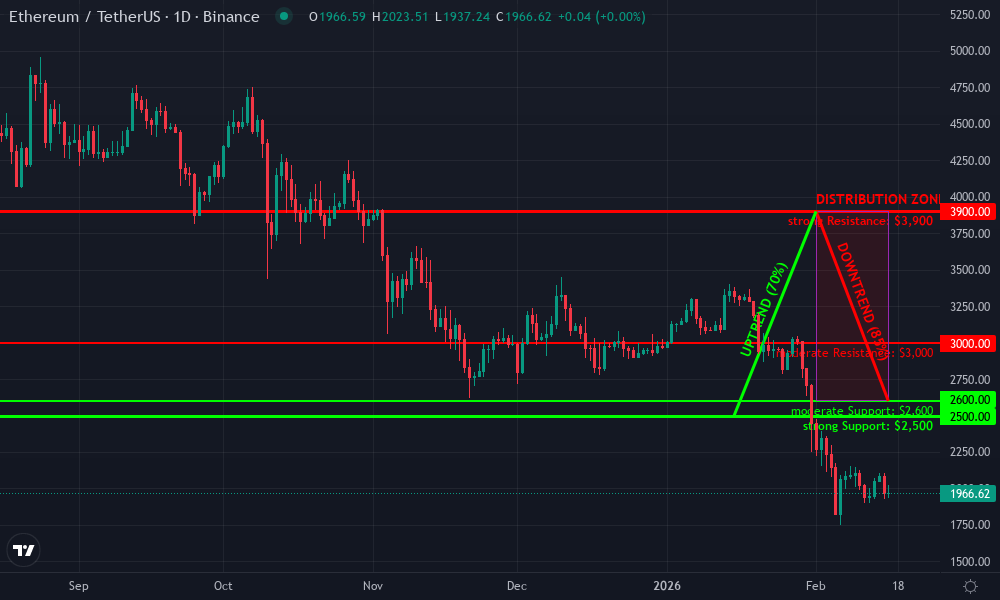
Analysis by Market Analyst | Symbol: BINANCE:ETHUSDT | Interval: 1D | Drawings: 7
Technical Analysis Summary
To annotate this ETHUSDT chart effectively in my balanced technical style, start by drawing a prominent downtrend line from the January high around 3900 to the current February low near 2600, using 'trend_line' with red color for bearish bias. Add horizontal support at 2500 (strong) and resistance at 3900 (strong), using 'horizontal_line'. Mark the accumulation range mid-January from 2500-3000 with 'rectangle'. Use 'arrow_mark_down' at recent breakdown below 3000. Place 'callout' texts for volume divergence and MACD bearish signal. Finally, add 'long_position' entry zone near 2550-2600 support with medium risk, and 'short_position' continuation below.
Risk Assessment: medium
Analysis: Volatile swings with clear support but bearish structure; on-chain PnL selling pressure adds uncertainty per LedgerLynx data
Market Analyst's Recommendation: Wait for 2500 support test for long setup, medium position size; avoid chasing downside without confirmation
Key Support & Resistance Levels
📈 Support Levels:
- $2,500 - Strong multi-touch low from early Jan, volume shelf strong
- $2,600 - Minor intraday support holding current price moderate
📉 Resistance Levels:
- $3,000 - Recent breakdown level, prior consolidation high moderate
- $3,900 - Swing high from early Feb rally peak strong
Trading Zones (medium risk tolerance)
🎯 Entry Zones:
- $2,550 - Bounce from strong 2500 support with volume confirmation, aligned to medium risk medium risk
- $3,950 - Break and retest of 3900 resistance for short continuation medium risk
🚪 Exit Zones:
- $2,900 - Profit target at prior resistance flip 💰 profit target
- $2,200 - Stop below 2500 support invalidation 🛡️ stop loss
- $2,400 - Short profit at projected 618 fib extension 💰 profit target
- $4,100 - Short stop above 3900 high 🛡️ stop loss
Technical Indicators Analysis
📊 Volume Analysis:
Pattern: Rising on downside, divergence on upside rally
Bearish volume profile: spikes on red candles, weak on green, signaling distribution
📈 MACD Analysis:
Signal: Bearish crossover below zero line
MACD histogram contracting negative, line sloping down post-rally divergence
Applied TradingView Drawing Utilities
This chart analysis utilizes the following professional drawing tools:
Disclaimer: This technical analysis by Market Analyst is for educational purposes only and should not be considered as financial advice. Trading involves risk, and you should always do your own research before making investment decisions. Past performance does not guarantee future results. The analysis reflects the author's personal methodology and risk tolerance (medium).
Visualizing PnL through charts clarifies method impacts. Picture ETH's climb: FIFO locks in early low-basis gains, stabilizing reports; LIFO rides recency, volatile but potent for tax deferral.
Pitfalls, Best Practices, and a Conservative Path Forward
DeFi's siren call amplifies errors. Impermanent loss erodes LP positions silently, cross-chain bridges orphan lots, and MEV bots reorder your narrative. Trackers falter if they overlook these, inflating onchain pnl real-time views. My counsel: enable read-only wallet syncs, cross-verify with explorers like Etherscan or Solscan, and maintain raw tx logs as Awaken suggests.
Best practices distill to three pillars. First, standardize data capture: timestamp, FMV, hash, addresses. Second, test methods annually; simulate 2025 taxes now to pivot strategies. Third, consult CPAs versed in crypto, as OnChain Accounting's experts highlight in U. S. -centric discussions. Platforms like CoinTracking's 12 methods offer flexibility, but over-optimization courts audits.
For the prudent investor, defi pnl tracker adoption isn't optional; it's defensive infrastructure. DefiTaxLots. com embodies this ethos, fusing real-time visualization with FIFO/LIFO rigor across Ethereum, Solana, and Base. By prioritizing precision, you sidestep speculation's traps, turning DeFi's chaos into compounded advantage. In markets that punish the imprecise, such tools aren't luxuries, they're lifelines.



No comments yet. Be the first to share your thoughts!