
Visualize Impermanent Loss PnL for DeFi LP Taxes on Curve and Balancer

Liquidity providers on Curve and Balancer face a stealthy adversary in impermanent loss, which erodes returns as asset prices shift post-deposit. With Curve DAO token trading at $0.2851, down -0.0116% over 24 hours from a high of $0.2884 and low of $0.2681, LPs must track this divergence precisely for both performance analysis and tax compliance. Platforms like DefiTaxLots. com shine here, offering real-time onchain PnL visualization tailored for DeFi LP taxes, including FIFO/LIFO tax lot calculations that capture IL impacts upon withdrawal.

Curve’s Stablecoin Focus Minimizes IL Volatility
Curve Finance sets itself apart with pools optimized for stablecoins, where impermanent loss remains subdued due to high asset correlation. Unlike Uniswap’s constant product formula (x * y = k), Curve employs a stable swap invariant that accommodates multi-asset pools with low slippage. This design inherently limits IL; for correlated assets like USDC/USDT, even 20% price swings yield under 0.5% loss compared to holding. Yet, as Reddit discussions highlight, grasping Curve’s exact IL math demands diving into its amplification factor and virtual reserves model.
DefiTaxLots. com integrates these nuances, pulling onchain data to compute position values against hold strategies. LPs see IL as opportunity cost in real-time charts, essential when CRV hovers at $0.2851 amid subtle 24-hour fluctuations. This precision aids high-frequency traders in spotting when fees offset IL, turning potential losses into net gains.
Impermanent loss is the silent killer of yield farming, undermining liquidity provision’s core promise.
Balancer’s Weighted Pools Amplify IL Risks and Rewards
Balancer introduces flexibility with customizable weights in pools, but this power comes at a cost: heightened impermanent loss tax exposure during volatility. A 50/50 ETH/BTC pool might suffer 5.7% IL on a 2x price ratio shift, per classic AMM math, while a 90/10 stable-volatile mix dampens it. Balancer’s native calculator visualizes this via 3D charts, yet lacks tax lot integration. Enter onchain trackers like DefiTaxLots. com, which layer curve balancer pnl tracker capabilities, simulating IL against tax basis across chains.

– Exchange Trading Account
– Intelligence Platform Access
– $100 Signup Bonus
Eligibility and available trading pairs vary by jurisdiction.
For tax-conscious users, Balancer withdrawals crystallize IL as capital loss, adjustable via cost basis methods. DefiTaxLots. com excels by timestamping LP events, calculating realized PnL inclusive of fees and IL, streamlining IRS-compliant reports.
Taxable Events Lurk in Every LP Interaction
DeFi LP taxes extend beyond IL; adding liquidity often qualifies as a swap, triggering capital gains on the appreciated asset. Exiting realizes the full position, with IL manifesting as shortfall versus initial value. Crypto accountants warn of double tax risk: entry/exit events plus non-deductible unrealized IL until withdrawal. ChainScore Labs clarifies IL as a realized event, demanding cost-basis tweaks.
Curve DAO Token (CRV) Price Prediction 2027-2032
Forecasts incorporating DeFi LP sentiment, impermanent loss impacts, tax implications, and broader market cycles from a 2026 base of $0.2851
| Year | Minimum Price | Average Price | Maximum Price |
|---|---|---|---|
| 2027 | $0.22 | $0.35 | $0.55 |
| 2028 | $0.28 | $0.48 | $0.85 |
| 2029 | $0.35 | $0.65 | $1.20 |
| 2030 | $0.45 | $0.90 | $1.80 |
| 2031 | $0.60 | $1.30 | $2.50 |
| 2032 | $0.80 | $1.80 | $3.50 |
Price Prediction Summary
CRV faces short-term bearish pressure at $0.2851 due to IL concerns and LP tax complexities, but long-term outlook is moderately bullish with 5x-10x growth potential by 2032, driven by DeFi maturation, improved IL tools, and stablecoin trading dominance amid crypto market cycles.
Key Factors Affecting Curve DAO Token Price
- DeFi adoption and Curve’s stablecoin swap dominance
- Impermanent loss visualization tools and fee offsets
- Regulatory developments on LP taxes and DeFi events
- Market cycles with potential 2028-2029 bull run
- Competition from Balancer/Uniswap and tech upgrades
- Broader crypto market cap expansion and CRV ve-token incentives
Disclaimer: Cryptocurrency price predictions are speculative and based on current market analysis.
Actual prices may vary significantly due to market volatility, regulatory changes, and other factors.
Always do your own research before making investment decisions.
Visualizing this requires tools beyond spreadsheets. DefiTaxLots. com’s onchain impermanent loss calculator dissects LP positions into tax lots, projecting PnL under price divergences. At CRV’s current $0.2851, LPs in CRV-rewarded pools must weigh IL against emissions, using precise trackers to avoid overpaying taxes on illusory gains.
Consider a Curve 3pool deposit: $10,000 split evenly across stables. Post-DAI depeg, withdrawal yields $9,800 equivalent, a 2% IL realized as loss. DefiTaxLots. com charts this trajectory, benchmarking against HODL, empowering decisions before tax season chaos.
DefiTaxLots. com elevates this analysis with interactive technical_chart overlays, plotting LP value versus hold value in real-time. Traders spot breakeven points where swap fees eclipse IL, critical as CRV lingers at $0.2851 with its 24-hour range from $0.2681 to $0.2884 signaling subdued volatility.
Mastering IL Calculations: Curve vs. Balancer Formulas
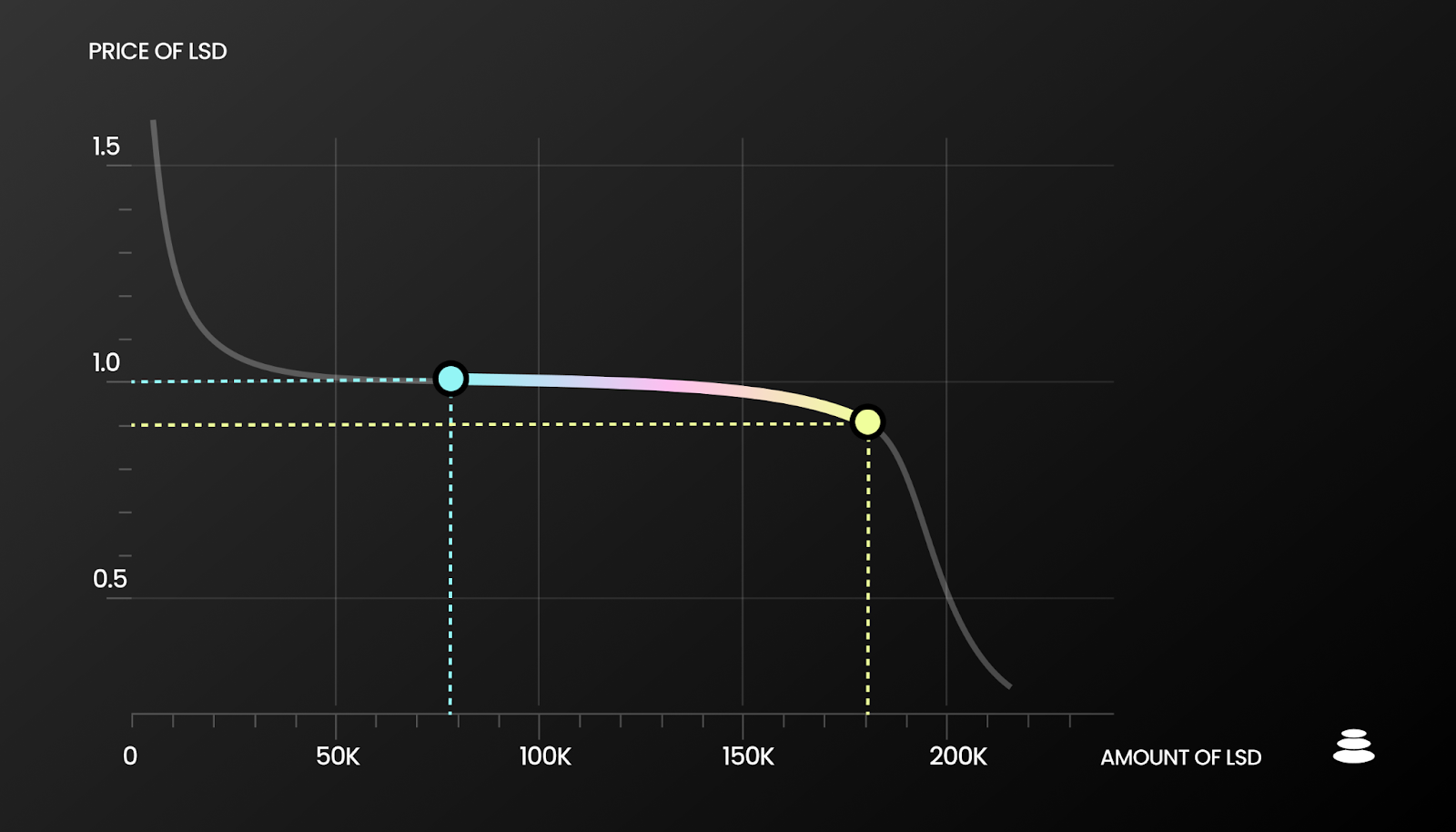
Curve’s IL computation diverges from Uniswap’s simplicity, incorporating an amplification coefficient (A) that tightens the bonding curve for stables. The formula approximates IL as 4A/(4A and 1) * sqrt(r) – sqrt(r)/(1 and sqrt(r)), where r is the price ratio. For A=100 in a typical 3pool, a 5% deviation caps IL at 0.25%, far below Balancer’s weighted variant. Balancer generalizes to n assets with weights w_i, deriving IL from the geometric mean adjustment: value_LP/value_hold = product (p_i^{w_i}) ^{1/sum w}, exposing LPs to amplified risks in skewed pools.
Manual math falters in multi-chain, high-frequency scenarios. DefiTaxLots. com automates this via onchain impermanent loss calculator, ingesting pool state from subgraph queries to render precise PnL trajectories. At CRV’s $0.2851 price, it factors governance emissions, revealing when IL erodes rewards in veCRV-locked positions.
Impermanent Loss Formulas and PnL Examples for Uniswap, Curve, and Balancer Pools at Varying Price Ratios
| Platform | Simplified IL Formula | r=1 (No Change, IL %) | r=2 (2x Ratio, IL %) | r=5 (5x Ratio, IL %) | PnL Example ($10k Position at r=2) |
|---|---|---|---|---|---|
| Uniswap (50/50 CPMM) | 2√(r) / (1 + r) | 0% | -5.7% | -25.5% | -$570 |
| Curve (StableSwap, A≈100-400) | Hybrid invariant (low IL for stables) | 0% | -0.4% | -4% | -$40 |
| Balancer (50/50 Weighted CPMM) | √(x) √(y) = k (equiv. Uniswap) | 0% | -5.7% | -25.5% | -$570 |
| Balancer (80/20 Weighted CPMM) | x^{0.8} y^{0.2} = k (approx.) | 0% | ~-2%* | ~-10%* | ~$ -200* |
Tax Lot Tracking: FIFO/LIFO in LP Withdrawals
DeFi LP taxes demand granular tax lot assignment, as IL realization scrambles cost basis across assets. FIFO assumes earliest deposits exit first, potentially inflating gains if stables appreciate unevenly; LIFO flips this for recent entries. DefiTaxLots. com supports both, timestamping onchain LP mints/burns to allocate basis accurately. Withdraw a Balancer position amid ETH surge? The tool computes swapped equivalents, deducting IL as loss against original holdings, compliant with IRS notice 2014-21 deeming crypto swaps taxable.
Crypto accountants emphasize documentation: every zap-in or gauge deposit logs as events. Platforms ignoring IL overstate PnL, inviting audits. DefiTaxLots. com’s curve balancer pnl tracker exports CSV-ready reports, slicing positions by chain, pool, and method, saving hours in tax prep.
Comparison of IL Exposure Across DeFi Pools
| Pool | IL Exposure at 5% Deviation | Est. Annual Fees Offset (APR) | Tax Impact |
|---|---|---|---|
| Curve 3pool | 0.25% | 3-5% | Low IL due to stablecoins; double tax on entry/exit + realized loss on withdrawal |
| Balancer 80/20 | 1.2% | 2-4% | Moderate IL in weighted pools; taxable events on LP actions + IL realization |
| Uniswap V2 (50/50) | 2.5% | 1-3% | High IL; full double tax risk + capital loss on IL |
Offsetting IL: Fees, Rewards, and Strategic Pool Selection
IL isn’t fatal; Balancer pools with 0.5% fees can offset 3% losses annually via volume. Curve’s low-slippage design boosts this, especially in crvUSD or LST pools where correlation nears 1.0. Yet, at CRV $0.2851 down -0.0116% daily, LPs hedge by diversifying into correlated tri-crypto pools, minimizing divergence.
DefiTaxLots. com quantifies net yield: IL and fees – gas, benchmarked to HODL. High-frequency traders leverage its API for alerts when IL breaches 1%, prompting rotations. This edge separates pros from retail, as emotions lure into volatile pools while data demands restraint.
Charts don’t lie; emotions do. Track IL ruthlessly to master DeFi liquidity.
Seasoned LPs rotate into Curve’s tricrypto pools during BTC rallies, where IL averages 1.5% versus 5% in Balancer volatiles. DefiTaxLots. com simulates these under live data, projecting tax-adjusted APRs. Withdraw amid CRV at $0.2851? Export FIFO lots showing $500 IL offset by $1,200 fees, netting positive reportable income.
For multi-wallet empires, aggregation shines: unify Polygon, Arbitrum, Ethereum LPs in one dashboard. Tax filers dodge double-counting, as IL across chains demands unified basis tracking. No more Excel horrors; onchain fidelity ensures audit-proof precision.

DeFi evolves, but IL and taxes persist as constants. Platforms like DefiTaxLots. com arm users with visualization that turns opacity into opportunity, ensuring every LP decision balances yield, risk, and compliance seamlessly.