
Get DeFi tax lots right
Before you calculate your cost basis, you need to define what you are tracking. DeFi activity creates taxable events that traditional portfolios do not. Staking rewards, airdrops, and liquidity pool deposits all have specific tax treatments. If you treat a liquidity pool deposit as a simple transfer, you may lose your cost basis and trigger phantom gains.
Start by identifying the asset class for each token. Staking rewards are ordinary income at the fair market value on the day received. Airdrops are also ordinary income. However, providing liquidity to a pool is different. You are exchanging one asset for another, which is a taxable swap. You must record the cost basis of the tokens you put in and the value of the LP tokens you receive.
You also need to decide on a cost basis method. Most traders use FIFO (First-In, First-Out) or HIFO (Highest-In, First-Out). HIFO often reduces your tax bill by matching the highest cost tokens against your gains. Choose one method and stick with it. Switching methods requires IRS approval and creates reporting chaos. Document your choice in your tax notes.
Finally, gather all transaction data. DeFi wallets do not send 1099 forms. You must export your CSVs from block explorers or tax software. Ensure you have records of every swap, deposit, and reward claim. Without this data, you cannot accurately calculate your capital gains or losses.
How to track DeFi tax lots in 2026
DeFi activity is fully taxable. Staking rewards, airdrops, and liquidity pool deposits all create taxable events that require careful lot tracking. Without a clear record of your cost basis, you risk overpaying taxes or facing audits. Follow this sequence to organize your DeFi tax lots accurately.

Start by importing all wallet history into a tax software. DeFi transactions often span multiple blockchains, so ensure your tool supports EVM, Solana, and other relevant networks. Record the exact timestamp for every swap, deposit, and reward claim. The IRS uses the date of receipt to determine if an asset is short-term or long-term.

When you receive staking rewards or airdrops, their fair market value at the time of receipt becomes your cost basis. For liquidity pool deposits, the cost basis is the value of the tokens you provided. Keep these records separate for each token pair. If you deposit ETH and USDC into a pool, track the cost basis for both assets independently.
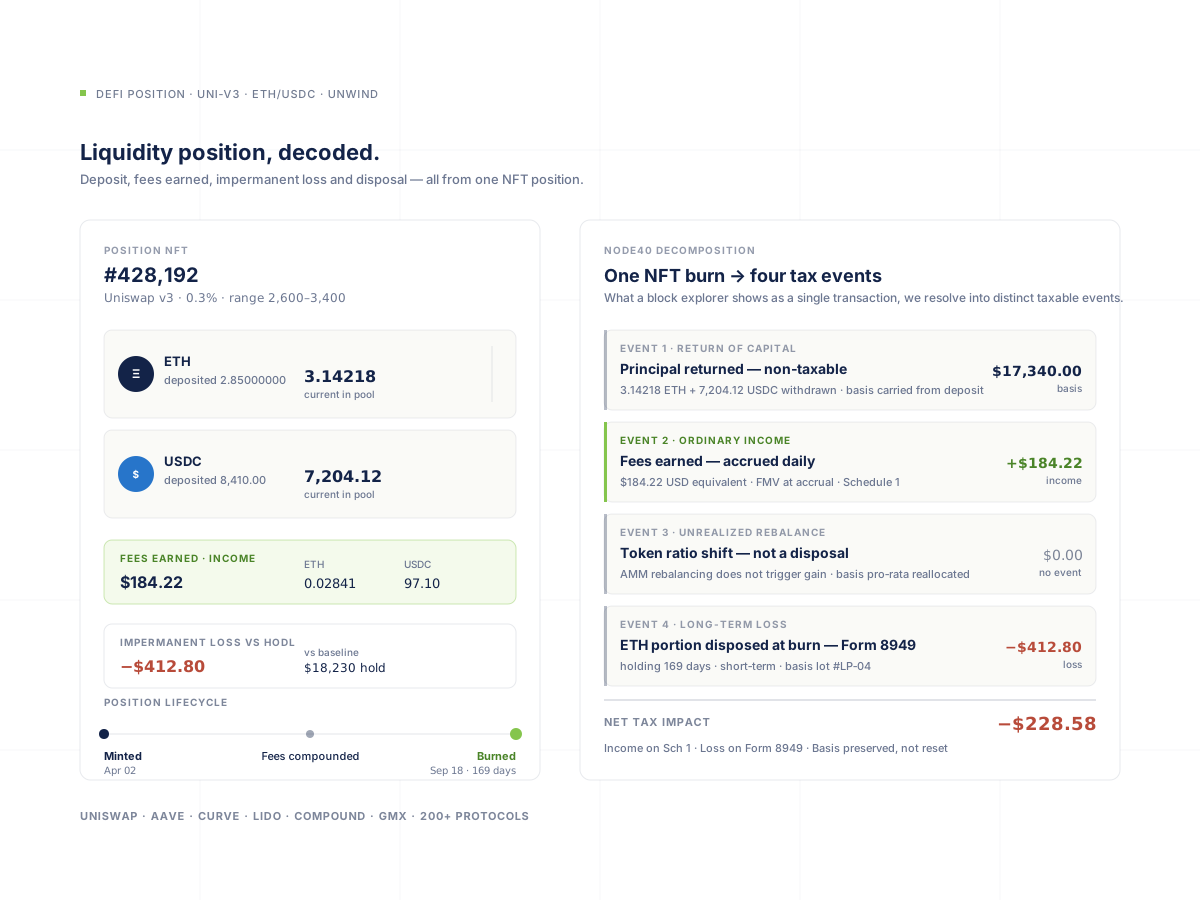
Withdrawing from a liquidity pool is a taxable event. You must calculate the gain or loss for each token withdrawn compared to its original cost basis. Impermanent loss does not create a deductible loss for tax purposes; only the final sale or swap value matters. Document the LP token exchange rate at withdrawal to ensure accurate cost basis allocation.

Map your tracked lots to IRS Form 8949. Short-term gains go in Part I, long-term in Part II. Ensure your tax software correctly identifies which transactions are taxable events versus non-taxable transfers between your own wallets. Double-check that all airdrops and staking rewards are included in your income.
Fix common DeFi tax lot mistakes
Even with advanced tracking software, manual errors in DeFi tax lots remain the primary cause of IRS notices. Because decentralized protocols execute transactions differently than centralized exchanges, standard tax lot methods often fail to capture the true cost basis. Identifying these specific pitfalls before filing is essential for avoiding underpayment penalties or audit triggers.
Ignoring the taxable event on staking rewards
Many users believe that staking rewards are not taxable until they are sold. This is incorrect. The IRS treats staking rewards as ordinary income at the fair market value when they enter your wallet. If you stake ETH or SOL, the value of the reward token at the moment of receipt becomes your cost basis. Failing to record this initial value creates a distorted cost basis when you eventually sell, leading to inaccurate capital gains calculations.
Mislabeling airdrops as non-taxable income
Airdrops are frequently overlooked because they arrive unexpectedly. However, if you have control over the tokens, they are taxable as ordinary income. The value is determined by the price at the time you claim or receive the token. If you receive an airdrop worth $500, that $500 is income. When you later sell those tokens, your cost basis is that same $500. Treating airdrops as free money with no tax implications is a common and costly error.
Confusing liquidity pool entries with taxable swaps
Adding liquidity to a pool is generally not a taxable event, but withdrawing is. When you remove liquidity, you are effectively selling your share of the pool. This triggers a capital gains event on the difference between your original contribution value and the value of the assets you receive back. Many users fail to track the individual token ratios in their LP positions, making it impossible to calculate the correct cost basis upon withdrawal.
Overlooking impermanent loss adjustments
Impermanent loss affects the value of your liquidity pool shares but does not directly create a tax deduction. It is a paper loss until you withdraw. However, if you withdraw during a period of high impermanent loss, you may realize a lower capital gain or a higher capital loss than expected. Understanding this distinction helps you plan your exit strategy to minimize tax liability without confusing accounting with market performance.
Defi tax lots 2026: what to check next
Tax lots and DeFi tax reporting rules remain strict in 2026. The IRS treats decentralized finance activities as taxable events under current digital asset regulations. You are responsible for tracking cost basis, even if the platform does not issue a 1099.
Will crypto be taxed in 2026?
Yes. All crypto activity, including staking rewards, airdrops, and liquidity pool interactions, is fully taxable. While certain DeFi activities are not yet subject to broker reporting, the underlying tax liability still applies. You must report income at fair market value when received and capital gains when sold or swapped.
How much capital gains do I pay on $300,000?
Your rate depends on your total taxable income and filing status. Short-term gains (assets held one year or less) are taxed as ordinary income, potentially reaching 37%. Long-term gains (held over one year) are taxed at 0%, 15%, or 20%. High earners may also owe the 3.8% Net Investment Income Tax on these gains.
Does the IRS know if you sell Bitcoin?
The IRS has access to data from centralized exchanges that comply with tax reporting rules. While private wallets and non-custodial DeFi protocols currently lack direct broker reporting, the IRS can still trace transactions through blockchain analysis and subpoenas. Ignoring these transactions does not eliminate your obligation to report them.
How to legally avoid crypto taxes?
You cannot legally "avoid" taxes on realized gains, but you can minimize them through tax-loss harvesting and long-term holding strategies. Selling assets at a loss offsets gains, and holding assets for over a year qualifies for lower long-term capital gains rates. Never trade on the assumption that DeFi anonymity provides a tax exemption.
No comments yet. Be the first to share your thoughts!